
Vietnam's ASIAD karate gold: the leap from 25th to 12th and the data still left open
**Câu trả lời cốt lõi:** Karate Việt Nam giành huy chương vàng Á vận hội ở nội dung kata đồng đội nữ trước Iran, với kết quả được thuật lại là 5-0, đưa đoàn từ hạng 25 lên hạng 12 và đứng thứ ba Đông Nam Á. Bản tin gốc không nêu nguồn và tự mâu thuẫn giữa lần đầu vô địch và bảo vệ ngôi vô địch. **Dữ kiện chính:** - Kata đồng đội nữ gồm Bùi Ngọc Nhi, Nguyễn Thị Ngọc Trâm, Hoàng Thị Thu Uyên; chung kết gặp Iran, kết quả thuật lại 5-0. - Bùi Ngọc Nhi thêm huy chương đồng kata cá nhân; Nguyễn Thị Diệu Ly huy chương đồng kumite hạng 68 kg nữ. - Bảng xếp hạng ưu tiên vàng: Việt Nam 1 vàng, 0 bạc, 3 đồng, xếp sau Thái Lan (4 vàng) và Myanmar (1 vàng, 1 bạc, 1 đồng). - Karate dự Olympic Tokyo 2020 ngày 5–7 tháng 8 năm 2021 tại Nippon Budokan, bị loại khỏi Paris 2024; Á vận hội 2026 tổ chức tại Aichi-Nagoya, Nhật Bản. - Bản tin gốc chứa mâu thuẫn nội tại: tiêu đề huy chương vàng đầu tiên và dòng bảo vệ ngôi vô địch Á vận hội. **Nguồn:** Bản tin gốc không nêu tên cơ quan báo chí hoặc dịch vụ kết quả chính thức, và không ghi ngày xuất bản. Dữ liệu cần đối chiếu với bảng huy chương chính thức của Hội đồng Olympic châu Á. **Hỏi đáp liên quan:** - Hỏi: Tỷ số 5-0 trong chung kết kata nghĩa là gì? Đáp: Nhiều khả năng vòng đấu dùng thể thức năm giám khảo giơ cờ và cả năm chọn đội Việt Nam, thay vì tổng điểm kỹ thuật và thể chất. - Hỏi: Vì sao một huy chương vàng đưa đoàn Việt Nam từ hạng 25 lên hạng 12? Đáp: Bảng xếp hạng Á vận hội ưu tiên số huy chương vàng trước số bạc và số đồng, nên một vàng có sức nâng hạng rất lớn. - Hỏi: Kata đồng đội có nằm trong chương trình Aichi-Nagoya 2026 không? Đáp: Cần đối chiếu danh mục môn thi đấu chính thức của Hội đồng Olympic châu Á; dữ liệu hiện chưa được xác minh.
On the tatami, three Vietnamese athletes stand in a horizontal line, arms relaxed at their sides, eyes fixed forward. Before the first foot leaves its position, there is a silence lasting about two seconds. In team kata, that silence is the hardest part of the routine. Three people must inhale on the same beat, must start on the same millisecond, must trace the full embusen — the prescribed floor pattern — with the same amplitude, and must stop at exactly one point, with no one half a foot out of place.
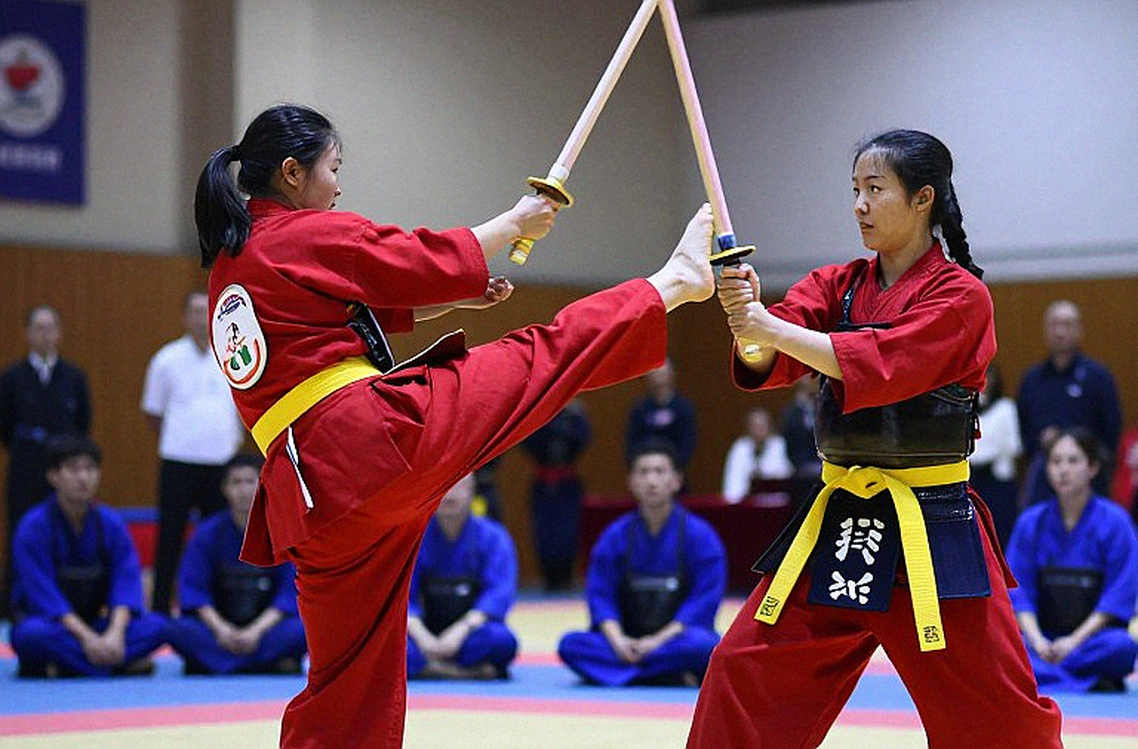
People remember the winner's name; I remember how a formation holds its silence before the routine begins. Bui Ngoc Nhi, Nguyen Thi Ngoc Tram and Hoang Thi Thu Uyen walked into the women's team kata final against Iran. The reported result was 5-0. That single fact made me stop, read the line a second time, and open my notebook.
Kata belongs to the scored disciplines, not the combat ones. Nobody wins by landing a harder or faster strike than an opponent; they win with a routine that scores higher on technical and athletic quality under the judges' scale. Kumite is the combat half, and at this edition of the Asian Games that half brought Vietnam a bronze in the women's 68 kg class, won by Nguyen Thi Dieu Ly.
A kata scorecard splits into two groups of criteria. The technical group covers stances, techniques, transitions, timing and accuracy of the floor pattern. The athletic group covers strength, speed, balance and the tension of the movement. Team kata adds one more criterion: synchronisation. It is the harshest of them all, because it belongs to no individual. Three athletes can each be excellent and still lose, simply because one of them entered the routine a tenth of a second early.
A point-scored kata final is normally decided by the sum of technical and athletic scores broken down by sub-criterion, not by a line like 5-0. That scoreline only makes sense if the round used the flag format: five judges, five ballots, all five choosing one side. If that is what happened, the result says something very specific — the judges did not split their votes, and that is the highest assessment a team kata routine can receive in a single round.
The report calls the performance convincing. In my trade, the word convincing only means something when it arrives with the judges' ballots, the per-criterion totals, or at minimum the number of votes in favour. Without those three, convincing is just an adjective the writer chose. I do not object to using it. I only want it to stand on a fact.
For karate, the Asian Games are no longer a side stage. Karate entered the Olympic programme at Tokyo 2026, competing across August 5, 6 and 7, 2026 at the Nippon Budokan, and was then dropped from Paris 2026. The Olympic road closed, the international calendar thinned, and the continental stage became the place that preserves value for a generation of athletes who had poured their entire competitive careers into it. Karate has featured at the Asian Games since 2026 in Hiroshima, but its standing in the continental system has never mattered this much.
Asian Games medal tables are ordered by the gold-first principle. One gold can lift a delegation very high, while five silvers cannot do the same. Vietnam was recorded as climbing from 25th to 12th after this gold. Under that ordering, the Southeast Asian sequence was logged as Thailand first with 4 golds, Myanmar second with 1 gold, 1 silver, 1 bronze, and Vietnam third with 1 gold, 0 silvers, 3 bronzes. That arithmetic explains the ranking leap, and it also reveals something rarely mentioned: Vietnam finished with more bronzes than Myanmar, yet still placed below, purely because of the ordering rule.
The women's team kata unit has three members. Among them, Bui Ngoc Nhi also took bronze in the individual kata event. This is the analytically richest fact in the whole story, because it shows she had to compete in two events inside a very short window. Kata wears down knees, ankles, wrists and lower backs through an enormous volume of repetition in training. Add concentrated competition load, and you get a fatigue-management problem that no statistics table displays.
When an athlete both wins team gold and reaches an individual podium, it usually signals a technical centre inside the squad. In team kata, the athlete who sets the rhythm determines most of the routine's quality, because the other two must follow. If Bui Ngoc Nhi is that rhythm-setter, then the individual bronze is not a secondary prize — it is technical evidence for the role.
Nguyen Thi Dieu Ly's medal in women's 68 kg kumite sends a different signal: the Vietnamese karate squad runs two pipelines in parallel, kata and kumite. That is the structure of a relatively mature karate nation rather than a small group concentrated on one discipline. To know whether that structure is thick or thin requires data the original report does not provide: squad size, the number of bouts fought before the final, qualifying-round results.
The 2026 Asian Games host is Aichi-Nagoya, Japan. For karate, this detail matters more than it appears. Japan is the birthplace of karate and one of the strongest nations in the discipline. A kata gold won on Japanese soil carries a symbolic weight quite different from one won on neutral ground.
There is one detail in the report I cannot pass over. The headline calls it Vietnam's first Asian Games gold. Another line in the same piece uses the phrase defending the Asian Games title. Those two statements cannot both be literally true. Either it is a first, or it is a defence. When a report contains two mutually exclusive propositions, the first thing I do is set both aside and go looking for the official medal table.
I once mispronounced a footballer's name at a World Cup, and that was the first time I understood what my job was. Since the summer of 2026 in Moscow, I have kept one rule: every proper name gets a pronunciation check before going on air, every fact passes through three independent sources before going into print. That rule makes me a few hours slower than other outlets. It also means my work never has to correct the results section. In this case, the three sources needed are the official Olympic Council of Asia medal table, Vietnam's karate history at previous Asian Games, and the scoring record of the final round.
There is also a point about professional grammar. Sports journalism tends to describe every victory with the vocabulary of combat sports: domination, knockout, submission. Applied to kata, that vocabulary sits in the wrong place. A kata team does not dominate an opponent, because they are not on the floor at the same time interacting with one another. They stand side by side and perform. What they defeat is their own previous rehearsal. The only way to win is to become so identical that three bodies turn into one movement.
The climb from 25th to 12th deserves a closer look. It does not reflect a shift in the athletic capacity of an entire sporting nation; it reflects how the table prioritises gold. Finishing third in Southeast Asia with one gold and three bronzes, while the delegation above holds one gold, one silver and one bronze, shows that the position was decided by a single moment rather than by depth of achievement. That does not make the medal smaller. It simply clarifies that the ranking leap is the story of a rule, not of a turning point.
What is worth tracking next is not the ranking. It is three questions that paperwork can answer: whether the official Olympic Council of Asia medal table confirms this figure; whether team kata is on the official competition list for Aichi-Nagoya 2026; and whether Vietnam has previously won Asian-level gold in kata.

The year 2026 taught me that an empty stadium can still be full of unanswered questions. A gold medal behaves the same way. It opens more questions than it closes. In kata, a routine only counts when three people finish at the same point, but that does not mean all three travelled the same road. Vietnamese karate has just finished a routine at the same point. The next task is to record that road clearly, in documents, before it becomes a beautiful memory nobody can verify.